
Our Unpredictable Irish Midlands Road Trip
12 November 2026
Our Halloween treat this year turned out to be quite the trick: an unpredictable road trip into the Irish midlands with our friends. We had started planning it weeks in advance. Our kids were super excited to spend two nights in an Airbnb in Tipperary with their friends. While we had an itinerary of sites to visit, the kids simply considered it a prolonged sleepover.
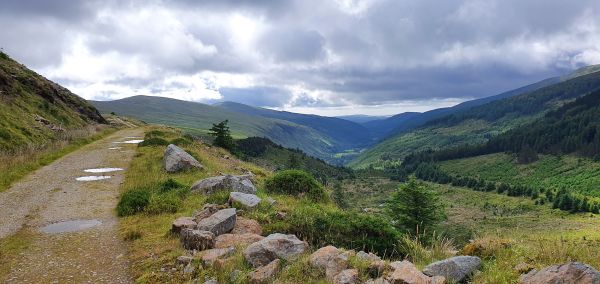
Prolonged also describes our car journey, which turned out to be a disaster. It started with a scenic drive through the Wicklow Mountains to avoid traffic on the M50. As expected for a Friday before a bank holiday weekend, the motorway was mad. Shortly after we emerged from the fairyland-like country roads of rural Wicklow, an object on the M7 motorway burst our tyre. My husband John felt confident that help would arrive soon, but I already dreaded what lay ahead of us.
It’s a Long Way to Tipperary…
With several breakdown services at our fingertips, we hoped they might solve the issue quickly. We spent the first half hour on the phone sussing out our options. After that, we could do nothing but wait. Luckily, the kids didn’t immediately realise how the breakdown impacted our journey. Eventually, after an hour of waiting and more phone calls, the reality trickled through to the back row. The excitement of arriving at the “fancy house” and picking their rooms was spoiled.
What looked like a delayed arrival soon threatened to cut the trip short entirely. When the tow truck finally arrived after two hours, no garage remained open to repair the tyre. Instead of sending someone to fix it, the service left us stuck in a dangerous spot on the side of the motorway with no obvious solution.
The Midnight Detour: Taxi Journeys and Rental Cars Not Fit for Purpose
Eventually, a taxi brought us to a rental car company in Naas. They promised us a relief car to continue our journey, assuring us they would repair our own car by the time we returned. That promise lifted the spirits of our exhausted but extremely patient little ones. We reached the company after 7:00 pm, waited another half hour for someone to arrive, only to discover the keys for the rental car were unavailable. If John hadn’t kept it together and made countless phone calls, I would have suffered a breakdown myself at that stage.
The company offered a replacement car at Dublin Airport. However, that meant a forty-minute drive in the wrong direction before tackling a two-hour journey to Tipperary. Instead, we settled for a second option that seemed equally ridiculous. Once more in a taxi, we travelled an hour and a half to Kilkenny. We repeatedly reassured ourselves that a proper family SUV would be waiting— one suitable for five people and a massive amount of luggage. Even though we were only staying for two nights, we had filled our boot to the top. It even included a large pot of spaghetti and meatballs, ready to share with our friends that night.
From Bad to Worse: The Midnight Push to Nenagh
Around 10:00 pm, we finally reached Kilkenny. Two of our three kids had fallen asleep in the taxi. Before transferring them, I wanted to make sure everything was in order. It wasn’t. Instead of the promised SUV, we received a small car that didn’t even fit John behind the wheel.
Furious, I decided to drive the final hour to Nenagh myself along dark, narrow country roads. En route, warnings for the motor oil and tyre pressure flashed onto the dashboard. Lacking other options, I anxiously pressed on. We arrived safely at midnight. Our friends had patiently waited and welcomed us into a warm house. With the kids finally tucked up in bed, John and I took a breather for the first time that day. Organising a functioning car for the weekend was a worry we left for the morning.
Reality Check at the Portumna Workhouse Centre
We refused to let this incredibly rough start ruin our weekend entirely. Instead of cancelling our itinerary for Saturday, we adjusted it slightly. After a lazy morning settling in, we left for Portumna, half an hour away. Our friends had booked a guided tour at the Irish Workhouse Centre, and the weather felt rather apt for visiting such a dark chapter of Irish history.

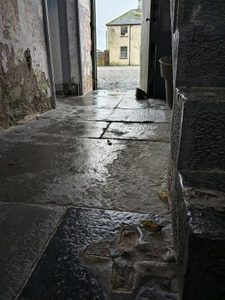
To escape the driving rain and strong breeze, we rushed towards the main entrance of the daunting building. We retraced the steps of the desperate people who had done the very same when the workhouse first opened in 1852. Workhouses operated in Ireland between 1840 and 1920. Run by the British government following the Irish Poor Law Act of 1838, about 163 workhouses opened across the country. Though designed to offer relief to the poorest and most vulnerable, the conditions inside were intentionally made harsh and degrading to keep people away.
A System to Break the Most Vulnerable
Spaces were limited and resources scarce. Anyone who sought help within these walls had exhausted every other path to survival. Upon arrival, the system immediately tore families apart. Officials strictly separated the inmates, classified as “paupers.” Only children under two years of age remained with their mothers. Men, women, and older children worked hard during the day and slept on straw mattresses in segregated, drafty dormitories.
Although the food provided a guarantee they couldn’t get on the outside, it was bland and lacked nutrition. In fact, meat was completely absent from the inmates’ diet; their bodies could no longer digest it after years of severe malnutrition. Within these walls, the system systematically dehumanised the poorest of the poor—largely from rural Ireland. No one formally mourned the deaths that occurred here. Family members living on the other side of the very same building often weren’t even informed when a loved one had passed away.


Putting everything in Perspective
Seeing the original rooms in the workhouse, emphasised by powerful art and modern sculptures, heavily impacted me. This part of Irish history wasn’t completely unknown to me, yet it cut deep. Facing the fate of so many individuals helped me visualise what the times must have been like. However, no history book or museum tour can come close to the reality that these people endured, particularly after the Great Hunger hit from 1845 to 1852.
The visit to the Portumna Workhouse Centre put everything into perspective for me. Yes, we had a horrendous start to our weekend. Only 24 hours before, I was at the end of my tether. Now I felt a wave of gratitude, despite our ongoing dispute with the rental car company. I was grateful for a husband who looked after everything. I was grateful that we can provide our kids with a warm bed each night—even the night before when we thought we wouldn’t. And I was grateful for that big pot of spaghetti and meatballs, which still waited for us in a warm, comfortable home.

The Rock of Dunamase
Finally equipped with the SUV promised to us from the start, we mapped out the remainder of the weekend. After a stop in the picturesque town of Killaloe and a picnic by the River Shannon, we continued to the Rock of Dunamase. Located in Co. Laois, it offered a convenient stop that cut our journey back home to Greystones in half. It looked interesting online, but that was all I knew about the site dating back to the 7th century.
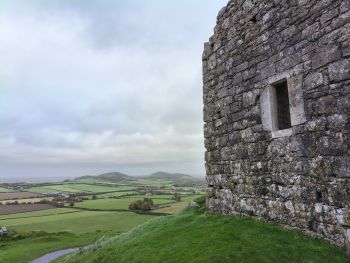
Attacked by the Vikings in 845, the early Christian settlement was destroyed. The ruins visible on the hill today belonged to an Anglo-Norman fortress from the 12th century. By the 14th century, Gaelic forces regained control of the region until its temporary abandonment shortly after. Cromwellian invaders blew up the fortress in the middle of the 17th century to prevent it from functioning as a rebel outpost.


Rising above Hardship and Battle
In a similar way to our workhouse visit in Portumna, the Rock of Dunamase left a deep impression. For one thing, it remains one of those underrated Irish sites, far from being a tourist trap. I love those! Secondly, it stirred something inside me. The ruins are barely recognisable for what they once were, yet they remain full of history and hundreds of individual stories. They tell tales of hardship and battle, but also of rising above one’s fate and enduring. What nation shows better endurance than the Irish across centuries of hardship?
Our journey was a true eye-opener and entirely different from what I had expected. Through our own stressful mishaps and the heavy history we uncovered, we came to value family and friendship much more consciously. One doesn’t have to suffer to sympathise with the hardships of others, but a bumpy road surely gives a necessary nudge towards gratitude and appreciation. Like all our journeys, this unpredictable Irish midlands road trip proved truly inspirational. As always, I am already looking forward to our next adventure in Ireland.
o my goodness Sylvia. Your amazing turning a nightmare into a positive. what a weekend. One you will not forget. Really interesting read about the workhouse and pass life Irish people lived. we are lucky x
Thanks Rebecca! Yes,the car incident was horrendous and went on for another week before we got our car back…But we really enjoyed the weekend away. Two places absolutely worth visiting!
Meine liebe Sylvia & zusammen die starke Familie John Payne !
In Zügen kannten wir Deinen Artikel schon aus den direkten Berichten,- umso mehr finde ich es literaisch interessant ES nochmals im Zusammenhang lesen zu können. Also I.) Reisen bildet immer mit oder ohne perfektem PKW-Service. Damit II.) zum Inhalt +Text (daraus) hin selber: 💯❤️ mit🥁- Wirbel a.- la John ” Bonzo” Bonham ;-). Und der konnte das genauso gut wie Du heute. Nicht schreiben, aber unvergesslich Trommeln 🙂.
Grüße O´Paps
Danke lieber Papa! Ja, unsere Trips sind immer wieder eine Inspiration und liefern genug Stoff für (offensichtlich gute) Geschichten 😊.