
A Whistlestop Journey through Irish Country Life
6 October 2026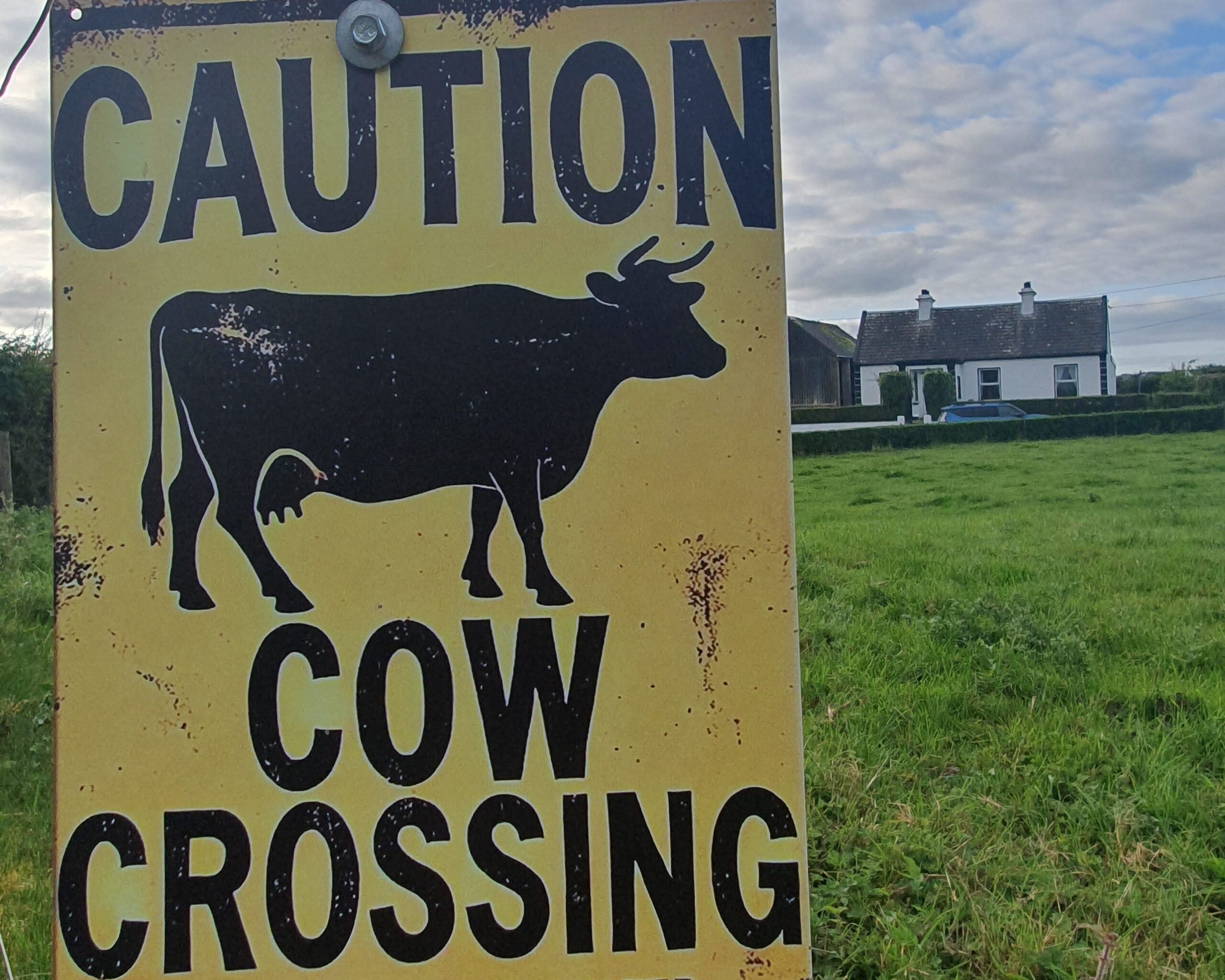
With three kids, we find it much more enjoyable to go on short trips rather than one long vacation. Over the last couple of years, we have explored different regions of Ireland this way, staying in gorgeous Airbnbs for two to three nights at a time. Our nine-, six-, and three-year-old are always super excited to visit what they call a new “fancy house.” Often, our accommodation isn’t fancy at all, but it perfectly suits our needs. The kids love arriving and settling in, but they are just as happy when it’s time to head home again.
The Reality of Irish Country Life
For our latest trip at the end of August, we chose an Airbnb near Knock and Knockmoy Abbey—two destinations that had been on my travel list for a while. The drive from our home in Wicklow wasn’t too long, but we had to plan our stops around fast EV charging stations, which are not quite a seamless part of Irish country life just yet. While my husband John looked after the technicalities of the drive, I was in charge of refreshments. I always pack aplenty to keep the back row content.
Once we left the monotonous M and N roads behind and drew closer to our destination—a tiny village near Williamstown in Co. Galway—the landscape shifted to rolling fields and farmland. Our youngest particularly enjoyed spotting the cows, horses, sheep, and donkeys scattered across the countryside.
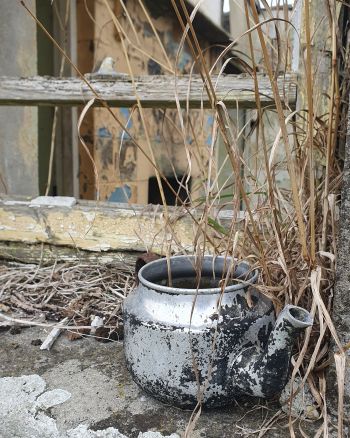
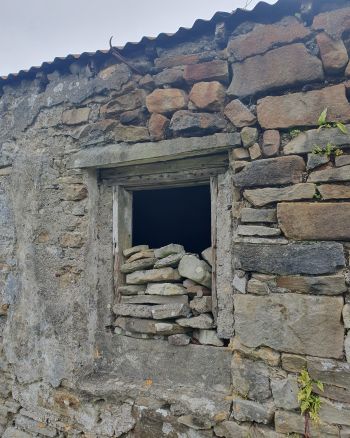
I, on the other hand, noticed a striking number of derelict cottages and farmhouses. Intrigued, I did some quick research and discovered that County Mayo holds the highest concentration of derelict buildings in Ireland. The county in the west of Ireland accounts for 14.1% of the national total—amounting to over 2,700 properties. At first I was surprised to find Galway ranking third, but then I realized we were in the very region driving those numbers: the borderlands of Co. Mayo.
Arriving at Bog Oak Cottage
I know better than to romanticise the Irish country life of the past. And yet, seeing so many remnants of a lifestyle once so vital to Ireland made me pensive. Especially since I have started reading historical fiction set in Ireland, which explores those very same traditions.
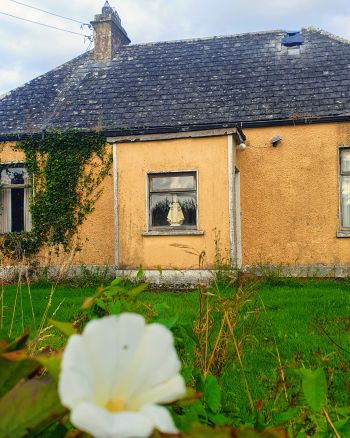
Right across from Bog Oak Cottage, where we stayed, I spotted a derelict yellow cottage. Resting in its window was a Child of Prague statue—a deeply rooted Irish tradition. Locals believe that placing this statue in the window or under a hedge will keep the rain away on your wedding day. Now it was sitting in an empty house that wasn’t going to be a home to a happy couple any time soon.
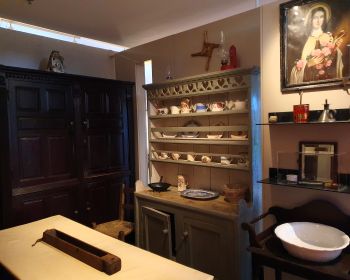
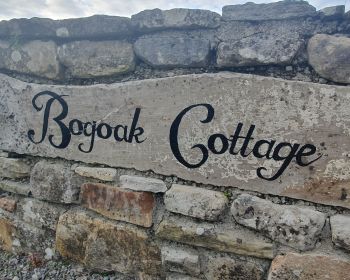
Bog Oak Cottage would have likely suffered the same fate if our hosts hadn’t transformed it into an Airbnb. Once home to a dairy farmer’s family, it was now a cozy accommodation, thoughtfully styled and decorated. Left mostly in its original layout but updated with a modern bathroom and appliances, it was the perfect fit for our trip. We were welcomed by a turf fire ready to light in the hearth, offering us our first real glimpse into Irish country life.
Museum of Irish Country Life – A Must-See
Initially, we hadn’t intended to stick to an “Irish country life” theme for the entire trip. However, once we stumbled across the National Museum of Irish Country Life while researching things to do in the area, we immediately added it to the itinerary. With the weather as Irish as it could get, it was the perfect day for a museum visit. There was an autumnal chill in the air, a sharp contrast to our home in Greystones, where summer hadn’t fully departed yet.
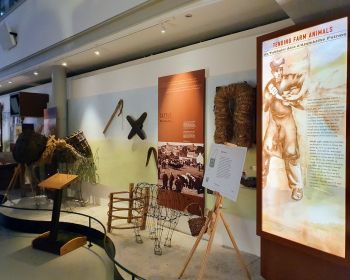
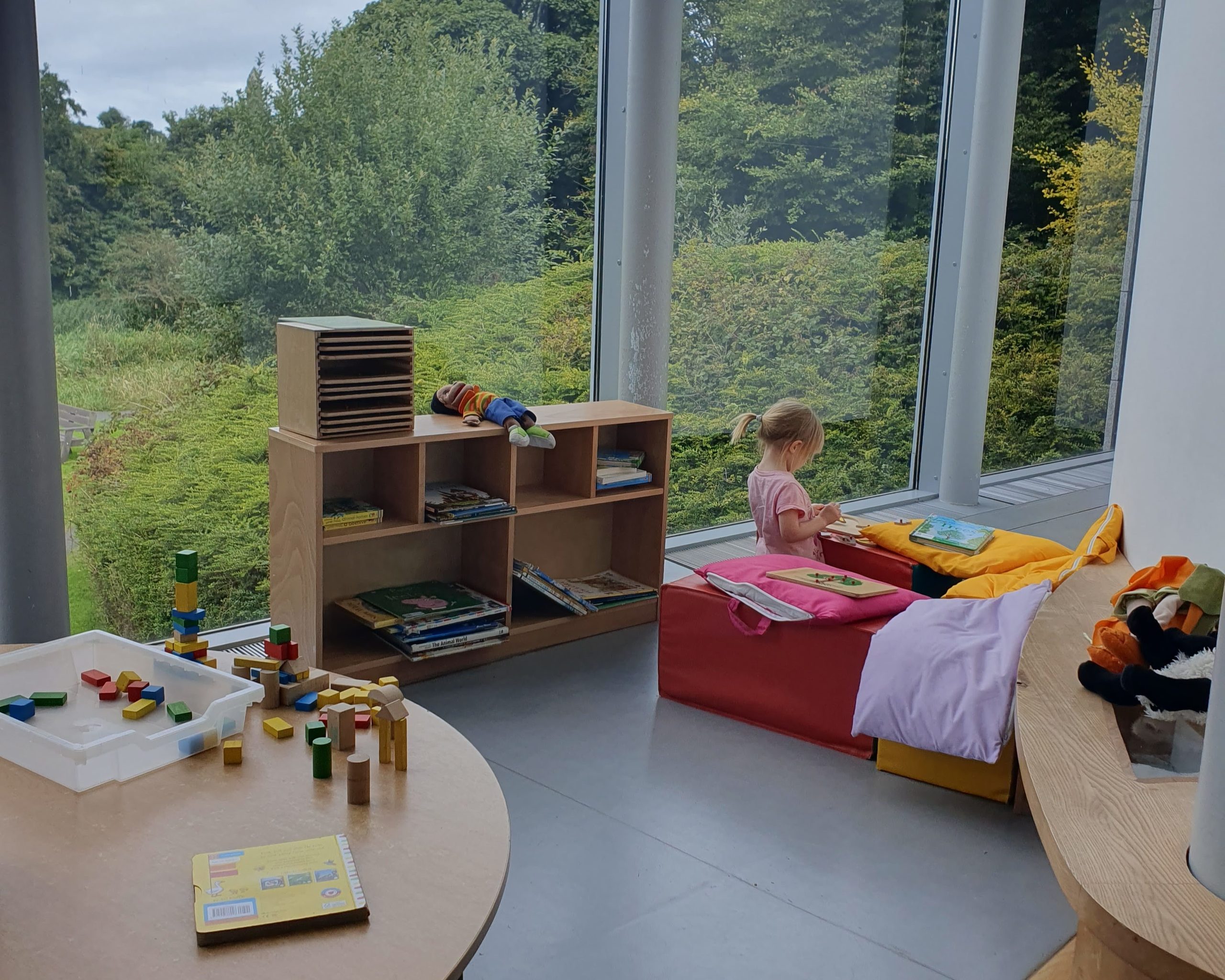
After a short drive to Turlough Park in Castlebar, we embarked on our educational journey through centuries of rural Irish history. The exhibitions were excellently structured and housed in modern, interactive display areas. The kids thoroughly enjoyed a museum quest to find items marked by the museum mascot. Because both the arts & crafts room and the play area were so well-stocked, John and I were able to browse the engaging displays in peace and quiet while our youngest busied herself with books and puzzles.
We concluded our visit with a picnic at the Woodland Playground. It contained moving stories and photographs of locals, remembering Irish country life in a deeply personal way. Our whole family agreed that Turlough Park was absolutely worth visiting, with plenty left to explore on a return trip.
Roadside Gem: Turlough Round Tower & Church
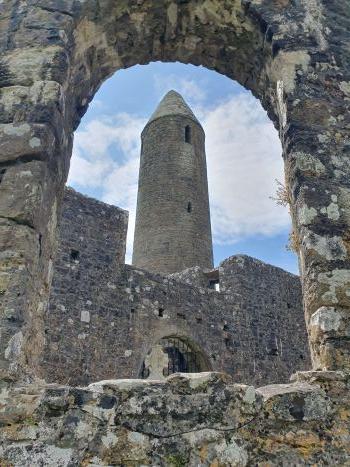
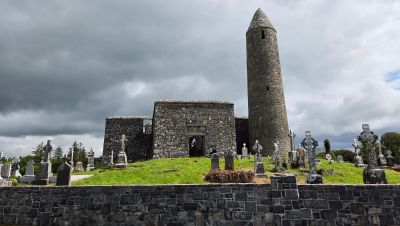
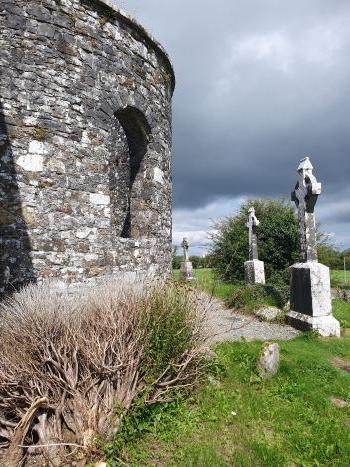
On exiting Turlough Park, we caught sight of a round tower across the road. We were eager to press on toward Knockmoy Abbey, as it promised to be a long day, but we couldn’t resist pulling over. Turlough Round Tower & Church, towering majestically on top of the hill, took our breath away. As has happened so many times before in Ireland, I was gobsmacked that a ruin of this scale—and, as we later learned, historical significance—was just sitting unattended on the side of a country road.
Believed to have been founded as a monastery by St. Patrick himself, the cemetery and abbey surrounding the 9th or 10th-century round tower are steeped in history. Some countries would have marketed the site as a precious tourist attraction and charged a fortune for entry. Not Ireland. While the country certainly has its tourist traps, many of its greatest historical gems are left completely open to the elements. In fact, they are my favorite places to visit. Just ancient walls, sweeping views, and my own imagination.
The Road to Knockmoy Abbey
While I was in awe after seeing the peaceful site at Turlough, I wasn’t sure if it was wise to add to the trip to see Knockmoy Abbey. The kids were tired by that stage and just wanted to get back to our cozy cottage. However, Knockmoy Abbey was one of the primary reasons I had planned the trip in the first place. My dad had read about its famous medieval tempera wall paintings. And I had promised him I would take pictures. Also, I was eager to see them myself.
But when our three-year-old started crying with frustration in the back seat and John missed the motorway exit, I was ready to abandon “Mission Knockmoy.” We couldn’t turn around for over 20 kilometers, and the atmosphere in the car turned tense fast. “Challenging the family peace better be worth it”, I thought to myself.
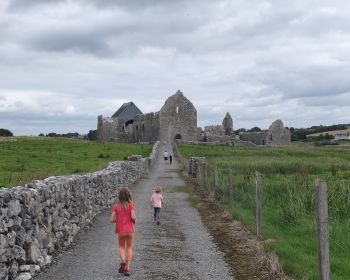
When the abbey finally became visible in the distance, I was relieved. Even better, there was no crowded parking lot or admission queue. Instead, we had to climb over a stone wall to gain access, making sure not to let out the grazing sheep. The kids were instantly on board again with our final adventure of the day.
History Through Children’s Eyes
Our kids love exploring old abbeys and monastic sites. They probably love them for entirely different reasons than we do, but they always make for our most relaxed visits. Rather than being stuck indoors in a boring museum (not Turlough Park!), they get to run free. While we give them small historical facts to trigger their imagination, they enjoy making up their own wild stories about the ruins.
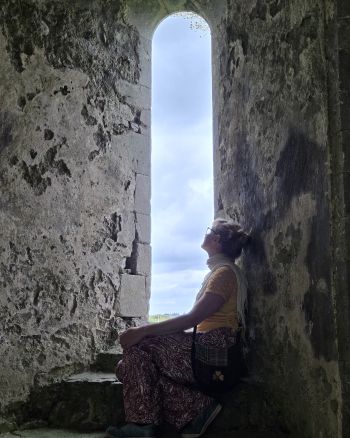
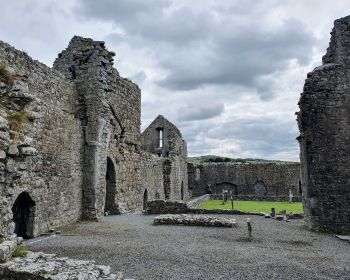
Knockmoy Abbey was no different. Once more the only visitors on site, we took our time admiring this mighty structure. It dates back to the 12th century when it was founded by the King of Connacht. The 15th-century wall paintings depict scenes from the legend of the Three Living and the Three Dead Kings, among others. Although barely visible today, they are incredibly rare—one of only four remaining medieval wall paintings in all of Ireland.
Our Visit To Knock Shrine
I expected our visit to Knock Shrine to be the highlight of our trip. Friends had gifted our son a full-year mass enrolment for his First Holy Communion, which gave us the idea to come here. I had never been to Knock before. And after seeing Fátima in Portugal a few years previously, I had high expectations of the Irish Marian apparition site.
Arriving in the tiny town of Knock was like stepping out of quaint Irish country life and straight into a tourist trap. I understand that the place has to cater for the masses, but arriving into the massive car park with a fenced, run-down playground was rather off-putting. The toilet facilities looked like they hadn’t been modernised since they were built decades ago. For many people, they are the first port of call, and their condition was truly a disgrace.
Just outside, a row of souvenir shops awaited with tacky items. Some were not even relevant to the site or spirituality whatsoever. We quickly ushered the kids past cheap, flashy rubber toys and large plastic containers sold for bottling holy water.
Mass Production instead Of Spiritual Experience
At the Knock Museum and Information Centre, a friendly lady gave us information on the 1879 apparition. Anything after that felt like an assembly line rather than a spiritual experience. The original gable wall of the parish church where the apparition took place was now covered by protective glass. There was a modern shrine in front of it. People were queuing to touch a bit of the original stone left exposed. Across, at the holy water fountains, visitors were filling up their three-litre containers or scrunched-up plastic bottles. To me, there was nothing ‘holy’ about it. It looked as if they were drawing free soda from a dispenser.
When it was time for mass, the crowds flocked into the gigantic, modern Knock Basilica. Stewards helped to seat people into the pews arranged 360 degrees around the altar. The service itself was beautiful, accompanied by lovely singing and a profound homily. But when it came to receiving Communion, people pushed in from the sides or jumped the line instead of waiting their turn. It felt nothing like our parish church back home, where our kids feel comfortable and respected as part of the community. Here it was just enduring a chaotic crowd.
People treated the Mary statue by the altar like a selfie backdrop or a wishing well. Some shoved and squeezed to get the best shot or to rub her foot for ‘good luck’. Maybe it was because of the sheer size of the Basilica or the volume of people, but it didn’t feel like a spiritual experience to me. I remember leaving Fátima in Portugal nurtured with spiritual food. Knock, on the other hand, I perceived as a drive-through pilgrimage with fast-food quality.
Finding Comfort in Irish Country Life
Often when the Irish try to enhance a visitor experience, they overshoot or miss their target altogether. I have seen many places in Ireland with a natural magic about them, diminished by a visitor experience that was supposed to be edifying. Having worked in the Irish travel business myself, I now tend to avoid places that have crossed over to mass tourism. There is so many places elsewhere in Ireland that still hold their special atmosphere. Like Turlough Round Tower and Knockmoy Abbey.
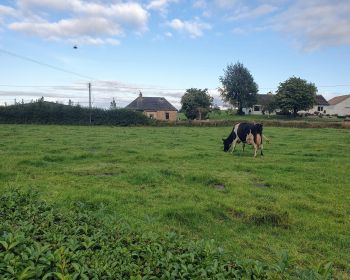
Whilst Knock disappointed, our whistlestop journey through Irish country life was truly energising. All it took was a cosy cottage in the middle of nowhere, with a cow peacefully grazing outside our window. Much like our kids, I love going away for a few days! And just as much, I enjoy coming home, full of new ideas and inspiration to write.
Great read. The bit about Knock made me think of a line from a Bell X1 song: „I’m a little all over the shop like those holy souvenirs from Knock that come all the way from China“. How sad and true!
If you’re ever in North Clare try Corcomroe Abbey. You’ll love it.
Thanks for your comment, Anja! I think the song line nails it! Corcomroe rang a bell and when I checked my photo archive we have actually visited it in 2018. Calls for a new blog post featuring my favourite abbeys in Ireland, don’t you think :)?
Beautiful! Thanks for bringing Ireland closer to the Canaries. Reading your lines felt as if I was on the trip myself.
Ah, thanks Kati! That is a great compliment indeed! The next trip is already planned and hopefully inspires me to a new article :).